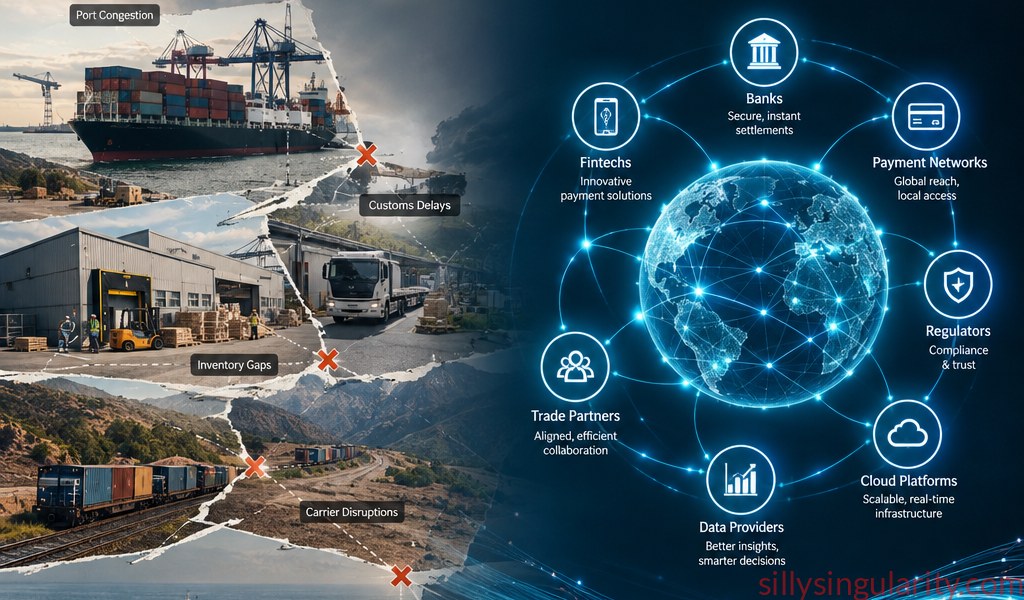
Blockchain promised to revolutionize everything from global supply chains to financial services. A decade later, the reality is more complicated. Some applications have flourished, others have quietly disappeared, and the technology’s most important impact may be happening somewhere few people expected.
Around 2016–2018, blockchain was arguably the most exciting technology in business.
Executives attended conferences about it. Consultants developed blockchain strategies. Technology companies launched pilot programs. Startups promised to transform entire industries.
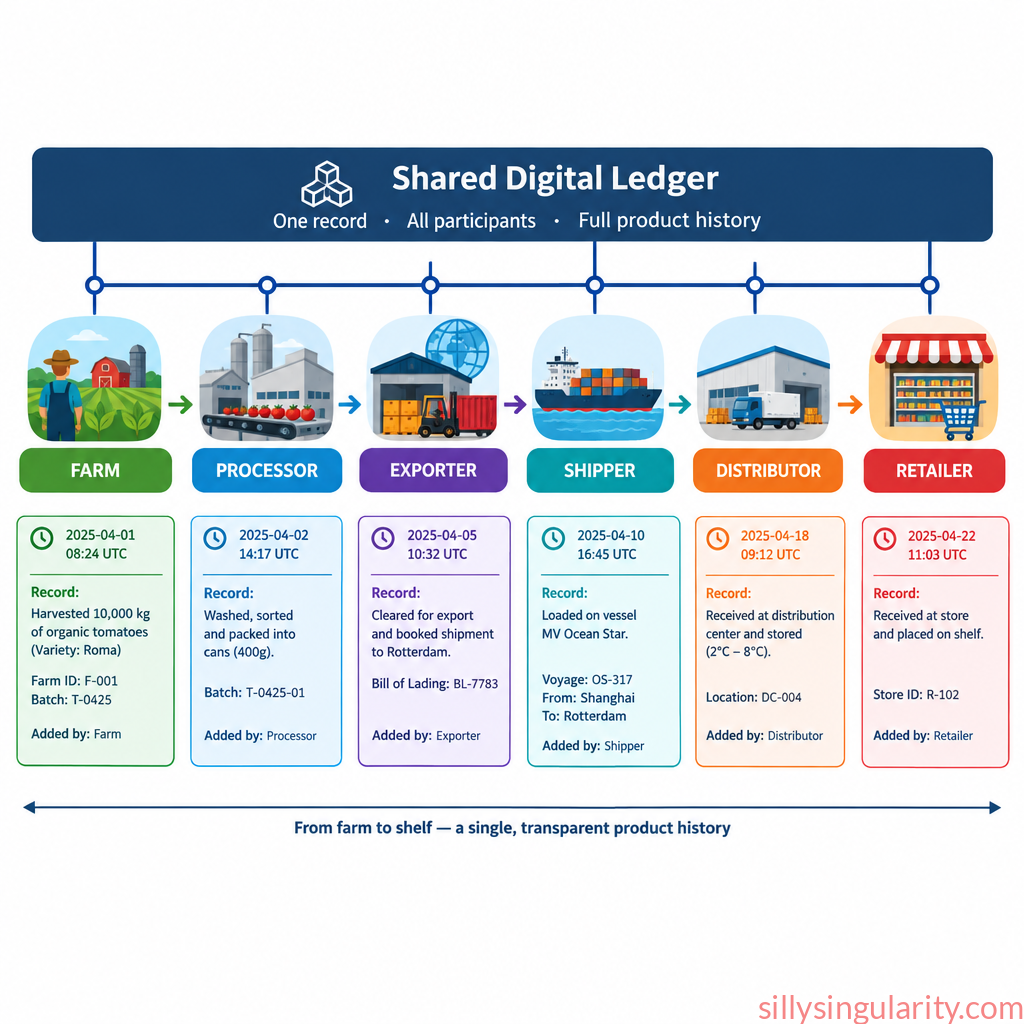
One particularly compelling proposition was supply-chain transparency. Imagine being able to trace a product from its origin to the consumer, with every participant recording transactions on a shared, tamper-resistant digital ledger. A supermarket could verify where its food came from. A manufacturer could authenticate components. A consumer could check the provenance of a product with a smartphone.
The vision was powerful: blockchain could create trust between organizations that didn’t necessarily trust one another.
Fast-forward to today. Has that revolution happened?
The short answer is yes, but not in the way its early advocates predicted.
Blockchain has helped create a substantial new digital asset industry, enabled new forms of financial infrastructure, and demonstrated interesting applications for transferring and managing value. But it has not fundamentally transformed most conventional businesses. Many of the high-profile enterprise initiatives that once generated excitement have been discontinued or scaled back.
Understanding why tells us something important about the relationship between technological innovation and commercial success.
The Supply-Chain Revolution That Never Quite Arrived
Supply-chain traceability was one of blockchain’s most promising enterprise applications.
Consider a simple product such as a bag of coffee. Its journey might involve a farm, an exporter, a shipping company, an importer, a roaster, a distributor and a retailer.
Each participant maintains information about the product. Unfortunately, those records may exist in separate systems, making it difficult to establish a consistent, trustworthy history.
The blockchain proposition was straightforward: create a shared digital ledger to which each participant contributes information. Once recorded, transactions become difficult to alter without detection.
In principle, a retailer could trace a product back through every stage of its journey.
There were genuine experiments.
Walmart and IBM explored blockchain-based food traceability through IBM Food Trust. The idea was to make it easier to identify the origins of food products, particularly when contamination or recalls occurred.
Another ambitious initiative was TradeLens, developed by IBM and shipping giant Maersk. Its objective was to digitize global shipping documentation and enable information sharing across the international shipping ecosystem.
TradeLens was a functioning platform, not simply a theoretical experiment. Nevertheless, IBM and Maersk discontinued it in 2023, citing the difficulty of achieving sufficient global industry collaboration and commercial viability.
This is perhaps the most revealing example of what went wrong.
The challenge wasn’t necessarily the technology. It was getting competing companies to agree to participate in a shared infrastructure.
Who would operate the platform? Who would own the information? Who would pay for it? Would competitors be comfortable sharing commercially sensitive information through a system associated with another major industry participant?
These questions proved considerably more difficult than building the blockchain itself.
There was another fundamental problem: blockchain can preserve information, but it cannot guarantee that the information originally entered was accurate.
If a supplier records that a shipment contains organic coffee from Colombia, blockchain can help prevent that record from being retrospectively altered. It cannot independently verify the coffee’s origin or organic certification.
The familiar computing principle of garbage in, garbage out still applies.
The result? Supply-chain digitization has continued to advance, but blockchain has not become the dominant infrastructure for global supply chains.
Where Blockchain Actually Found Its Market
While many enterprise applications struggled, blockchain found more durable applications in the financial world.
The reason is relatively straightforward: certain financial transactions benefit directly from having digitally transferable assets and a shared settlement infrastructure.
Four areas are particularly important.
1. Cryptocurrency Became a Major Digital Asset Industry
Bitcoin and other cryptocurrencies created an entirely new asset class.
An ecosystem of exchanges, digital wallets, custody providers, payment services and investment products has developed around them.
Whether cryptocurrencies ultimately prove to be productive investments or primarily speculative assets remains debatable. Nevertheless, the industry is now economically significant.
More importantly, blockchain demonstrated that digital assets could be transferred and held without relying on a single central operator to maintain the ownership ledger.
That was a meaningful technological achievement.
2. Stablecoins Are Becoming a Practical Financial Application
Perhaps the most interesting development is the growth of stablecoins.
Unlike Bitcoin, whose market price fluctuates considerably, stablecoins are designed to maintain a relatively stable value, commonly through a link to a conventional currency such as the US dollar.
Examples include USDC and USDT.
They allow digital dollars to move across blockchain networks, potentially enabling faster international transfers and operating around the clock.
For businesses operating internationally, this creates an alternative to some traditional payment and correspondent banking arrangements.
However, the headline transaction volumes can be misleading. Much blockchain activity involves cryptocurrency trading and transfers between wallets rather than payments for real goods and services.
McKinsey’s February 2026 analysis estimated actual stablecoin payments at approximately $390 billion annually, a small fraction of global payment activity.
This is meaningful adoption, but it is not yet a replacement for the international banking system.
3. Tokenization Could Reshape Financial Markets
Tokenization is arguably one of blockchain’s most promising emerging applications.
It involves representing ownership of an asset as a digital token on a blockchain.
Consider a government bond or money-market fund. Traditionally, ownership and transactions are recorded across financial institutions, custodians and settlement systems.
With tokenization, ownership interests can be represented digitally, potentially allowing transactions to settle more efficiently.
Potential applications include:
- Government bonds and money-market funds.
- Corporate debt.
- Real estate.
- Private equity and private credit.
- Trade finance.
BlackRock’s BUIDL fund, launched in 2024, is an important example of a traditional financial institution offering a tokenized investment product.
This is significant because it moves blockchain beyond cryptocurrency speculation and into conventional financial markets.
The potential benefits include faster settlement, improved collateral mobility, programmable transactions and reduced reconciliation between institutions.
There are still significant obstacles, including regulation, liquidity, interoperability and integration with existing financial systems.
Nevertheless, this is an area worth watching closely.
4. Smart Contracts and Decentralized Finance
Smart contracts are programs that execute transactions automatically when specified conditions are met.
For example, a digital lending arrangement could automatically release collateral when a loan is repaid.
Decentralized finance, commonly known as DeFi, uses these mechanisms to provide financial services such as lending, borrowing and trading.
These systems demonstrate that financial transactions can be automated without requiring every step to be managed by a conventional intermediary.
However, smart contracts are software, and software can contain vulnerabilities. DeFi has experienced substantial security failures, financial losses and market manipulation.
The technology is interesting, but it is not a risk-free alternative to conventional finance.
Why the Original Predictions Were So Optimistic
Looking back, I think the early blockchain enthusiasm underestimated five important challenges.
First, technology was mistaken for the solution.
Blockchain creates a particular type of shared record. It doesn’t automatically improve the business process surrounding that record.
In many situations, a conventional database is cheaper, faster and easier to operate.
Second, the trust problem was more organizational than technological.
Blockchain could theoretically enable competing organizations to share information without relying on a single trusted intermediary.
But organizations still need to agree on governance, access rights, commercial incentives, data standards and liability.
Those are difficult business problems, not programming problems.
Third, blockchain doesn’t guarantee accurate information.
A tamper-resistant record is only as useful as the information it contains.
Physical inspections, certification, trusted sensors and independent verification remain necessary in many applications.
Fourth, the economics were often unattractive.
Integrating blockchain with existing ERP systems, databases and operational processes could be expensive.
Companies needed a compelling financial benefit to justify the investment.
Frequently, that benefit wasn’t sufficiently clear.
Fifth, the industry confused pilots with adoption.
A successful demonstration involving five companies is not the same as a commercially sustainable network involving thousands of organizations.
The gap between proof of concept and widespread adoption was much larger than many early predictions suggested.
The Current State of Blockchain Adoption
It is useful to distinguish between the different markets rather than treating blockchain as a single technology application.
| Application | Current position | Outlook |
|---|---|---|
| Cryptocurrency | Established market | Continued evolution |
| Stablecoins | Growing adoption | Strong potential |
| Tokenized assets | Early but accelerating | Very promising |
| Decentralized finance | Established niche | Uncertain |
| Supply-chain traceability | Limited blockchain penetration | Selective adoption |
| Enterprise data sharing | Limited adoption | Use-case dependent |
| Digital identity | Limited mainstream adoption | Potentially valuable |
The important distinction is between the adoption of blockchain itself and the adoption of the business capabilities it was supposed to enable.
Supply-chain traceability, for example, is becoming more sophisticated even though blockchain hasn’t become its dominant underlying technology.
Likewise, digital payments continue to evolve through conventional infrastructure as well as blockchain-based systems.
The business problem can be successfully addressed without blockchain being the winning technology.
Has Blockchain Changed the World?
I would divide the impact into three categories.
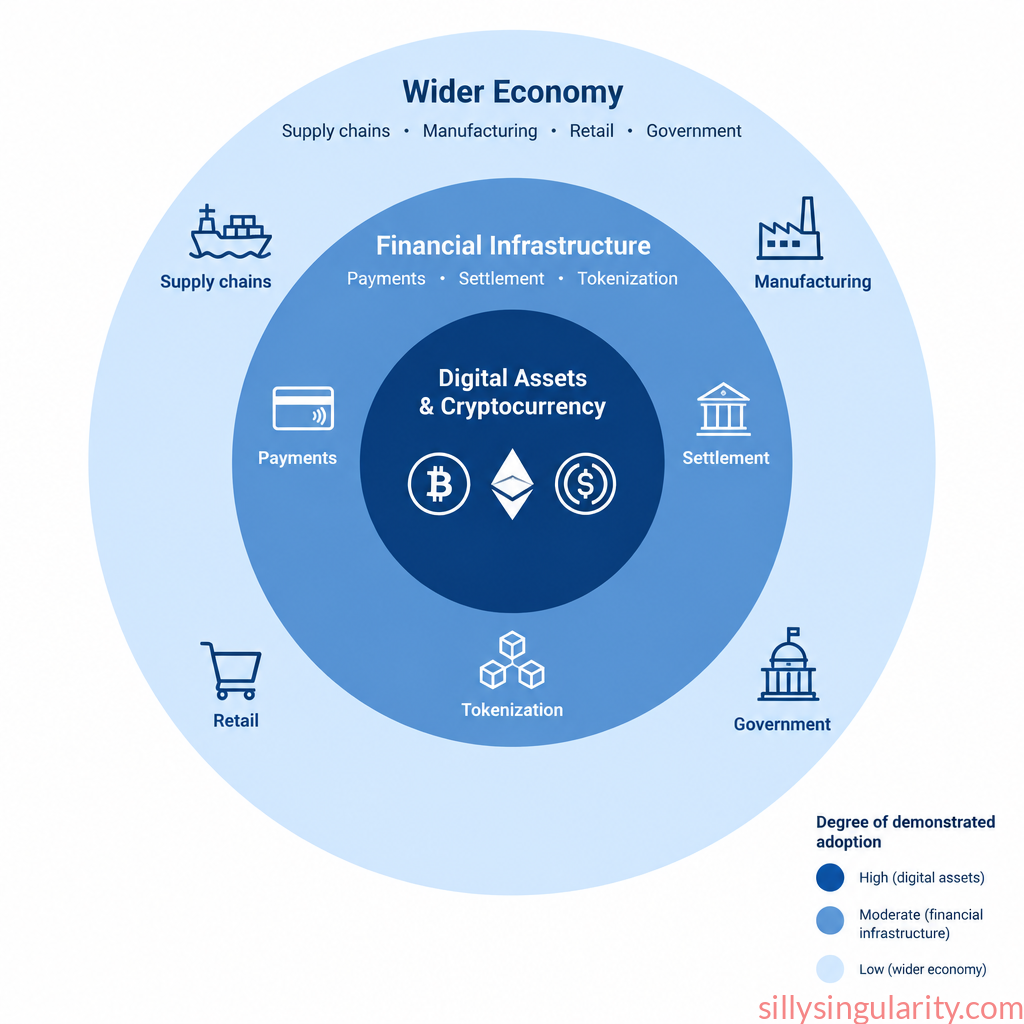
1. The cryptocurrency industry: Transformation already achieved.
Blockchain created a substantial new financial asset class, a new category of financial intermediaries and new ways of holding and transferring digital value.
That is a significant economic development, regardless of one’s views about cryptocurrency valuations.
2. Financial infrastructure: Transformation underway.
Stablecoins and tokenization are challenging conventional assumptions about how money, securities and ownership can be represented and transferred.
The potential is substantial, although the transition is far from complete.
3. The wider business economy: Much less impact than predicted.
Blockchain has not fundamentally transformed manufacturing, retail, logistics, procurement or most other conventional business processes.
Most companies still rely on traditional databases, ERP systems, conventional contracts and established information-sharing mechanisms.
The Most Interesting Possibility: Blockchain Becomes Invisible
There is an intriguing possibility that blockchain’s long-term success will look very different from the original vision.
Rather than replacing conventional business systems, it may become another layer of infrastructure underneath them.
A bank might use blockchain-based settlement without its customers knowing. A payment company might use stablecoins to move money between countries without the sender or recipient ever interacting with a cryptocurrency wallet.
A financial institution might use tokenization to improve settlement while continuing to offer customers conventional investment products.
In this scenario, blockchain succeeds not because everyone starts using blockchain applications, but because the underlying infrastructure becomes useful enough to integrate into existing services.
The Final Verdict
If I were evaluating blockchain as a business technology investment in 2016–2018, I would have been considerably more skeptical than the prevailing industry narrative.
The supply-chain proposition was intellectually attractive but had a fundamental weakness: it assumed that a shared ledger would solve the difficult problem of getting competing organizations to collaborate.
It didn’t.
However, I wouldn’t dismiss blockchain today.
Its strongest applications have emerged where there is a clear economic benefit from digitally transferable assets, programmable transactions and shared settlement infrastructure.
My prediction is that over the next decade, blockchain is more likely to transform parts of financial infrastructure than to transform the way ordinary businesses manage their operations.
Perhaps the most important lesson is that blockchain was never a universal solution to the problem of trust.
It is a particular technological mechanism for managing trust, with specific circumstances in which it makes economic sense.
For most business applications, a well-designed conventional database remains the better answer.
For some financial applications, blockchain is increasingly difficult to ignore.
And that, rather than the sweeping revolution once promised, may ultimately be blockchain’s real contribution.



The supply-chain section nails the real failure mode. TradeLens wasn’t killed by the tech; it was killed by the classic multiparty coordination problem. Competing firms won’t willingly share operational data on a platform controlled or even heavily influenced by a rival, and no amount of cryptographic immutability fixes incentive misalignment or commercial distrust. Garbage-in/garbage-out remains undefeated.
Where the article is strongest is the distinction between “blockchain changed the world” and “blockchain created a large new asset class and is now quietly improving certain financial plumbing.” Crypto and stablecoins are real economic phenomena. Tokenization is the more interesting long-term bet precisely because it doesn’t require every participant to become a blockchain maximalist; it can sit under existing products. BlackRock’s BUIDL is more telling than another enterprise pilot that dies after the press release.
The “invisible infrastructure” framing is the right one. The successful version of this technology doesn’t look like a consumer-facing revolution. It looks like settlement rails, collateral mobility, and programmable cash that most end users never see. That outcome is less romantic than the 2017 conference circuit promised, but it’s the one that actually matches how infrastructure usually wins.
One mild pushback: the article is still a bit gentle on the scale of the original overclaim. For several years the industry treated “shared ledger” as a near-universal solvent for trust problems. Most of those problems were never technical. They were governance, liability, and who captures the surplus. Blockchain didn’t solve those. In many cases it just made the negotiation more expensive.
Net: useful technology, narrowly applied, with its highest-value use cases still concentrated in finance. The rest of the economy largely found better ways to solve the same problems. That’s not failure. It’s just not the revolution that was sold.